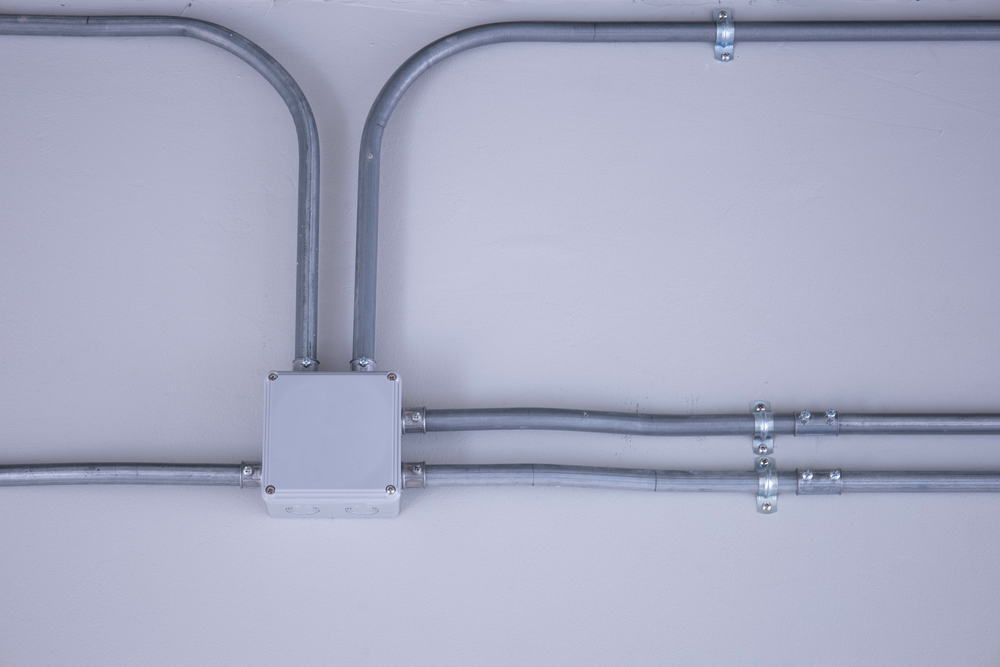
Conduit Installation: Plan Conduit Strap Placement in Advance
Planning strap placement in advance helps avoid costly rework and ensures your installation meets NEC and local code requirements from the start.
Conduit Strap Placement and Code Requirements
Proper conduit strap placement is governed by NEC guidelines and varies depending on conduit type, material, and application.
To the untrained eye, it might seem that contractors can place conduit straps wherever they feel like it. However, experienced electricians know that proper placement is critical for both safety and compliance.
For example, NEC guidelines for PVC conduit straps generally include:
- A strap must be placed within 3 feet of any outlet, panel, disconnect, or other juncture
- The distance between conduit straps should be no more than 10 feet along the run
- A strap should be placed on either side of every box or junction
- A strap should be placed on either side of every bend (including elbows)
- Every offset should be preceded by one strap immediately before it
These requirements form the baseline for conduit strap spacing, but local and state codes may require tighter spacing depending on conditions such as load, environment, or conduit type.
Failing to plan for strap placement can result in conduit runs that do not allow for proper support, forcing contractors to redo work in order to meet code.
Types of Conduit Straps and When to Use Them
There are several types of conduit straps used in electrical conduit installation, and choosing the right one depends on the conduit material, environment, and load requirements.
Common types include:
- One-hole conduit straps – Also known as snap-on straps, these are commonly used to secure EMT or rigid conduit to wood or masonry in lighter-duty applications
- Two-hole conduit straps – Provide greater stability and load capacity, making them ideal for larger conduit or heavier-duty installations
- Strut straps and clamps – Designed for attaching conduit to strut channel systems, often used in commercial or industrial settings
- Conduit hangers (minis or jiffy clips) – Used to suspend conduit from overhead supports or keep it spaced away from mounting surfaces
- Minerallac straps (heavy-duty straps) – Built for rigid conduit and demanding environments where additional strength is required
- Beam clamps and right-angle clamps – Used to secure conduit runs to beams or structural members at specific angles
- Service entrance (SE) straps – Designed for securing service entrance cable with a lower-profile fit
Material and Finish Options
Conduit straps are also available in different materials depending on the environment:
- Zinc-plated steel – Standard for indoor or dry environments
- Stainless steel – Ideal for corrosive environments such as coastal or industrial areas
- Aluminum – Lightweight and corrosion-resistant for many outdoor applications
- PVC or plastic – Non-conductive and commonly used with PVC conduit
Selecting the correct strap type and material ensures proper support, long-term durability, and compliance with electrical conduit installation standards.
Save Time on Conduit Installation with the Right Fasteners
Running conduit isn’t necessarily complicated, but it is time-consuming. Proper planning can reduce installation time by accounting for placement, spacing, and material needs in advance.
Contractors can also save time during conduit installation by choosing the right fasteners. That is where SPAX® comes in.
SPAX® all-purpose fasteners are ideal for conduit strap applications, even when fastening into masonry. Designed for strength, durability, and efficiency, they help streamline installation across a variety of materials.
- For wood applications: no pre-drilling required, just drive and go
- For masonry: properly sized pilot holes ensure smooth, efficient fastening
With the right tools and materials, contractors can complete installations faster without sacrificing quality or compliance.
Plan Your Conduit Installation for Better Results
Successful conduit installation depends on proper planning, from conduit routing to strap placement, spacing, and material selection.
Failing to plan for conduit strapping can lead to costly rework, especially if placement or spacing does not meet code requirements.
SPAX® engineered fasteners are designed with the same level of precision and planning in mind. Every product is built to improve efficiency, strength, and ease of installation in real-world applications.
We encourage contractors to take the same approach. Plan your conduit runs, determine proper strap placement, and select the right materials before starting the job.
With a solid plan in place, you’ll complete installations faster, reduce errors, and ensure long-term performance.